The feel
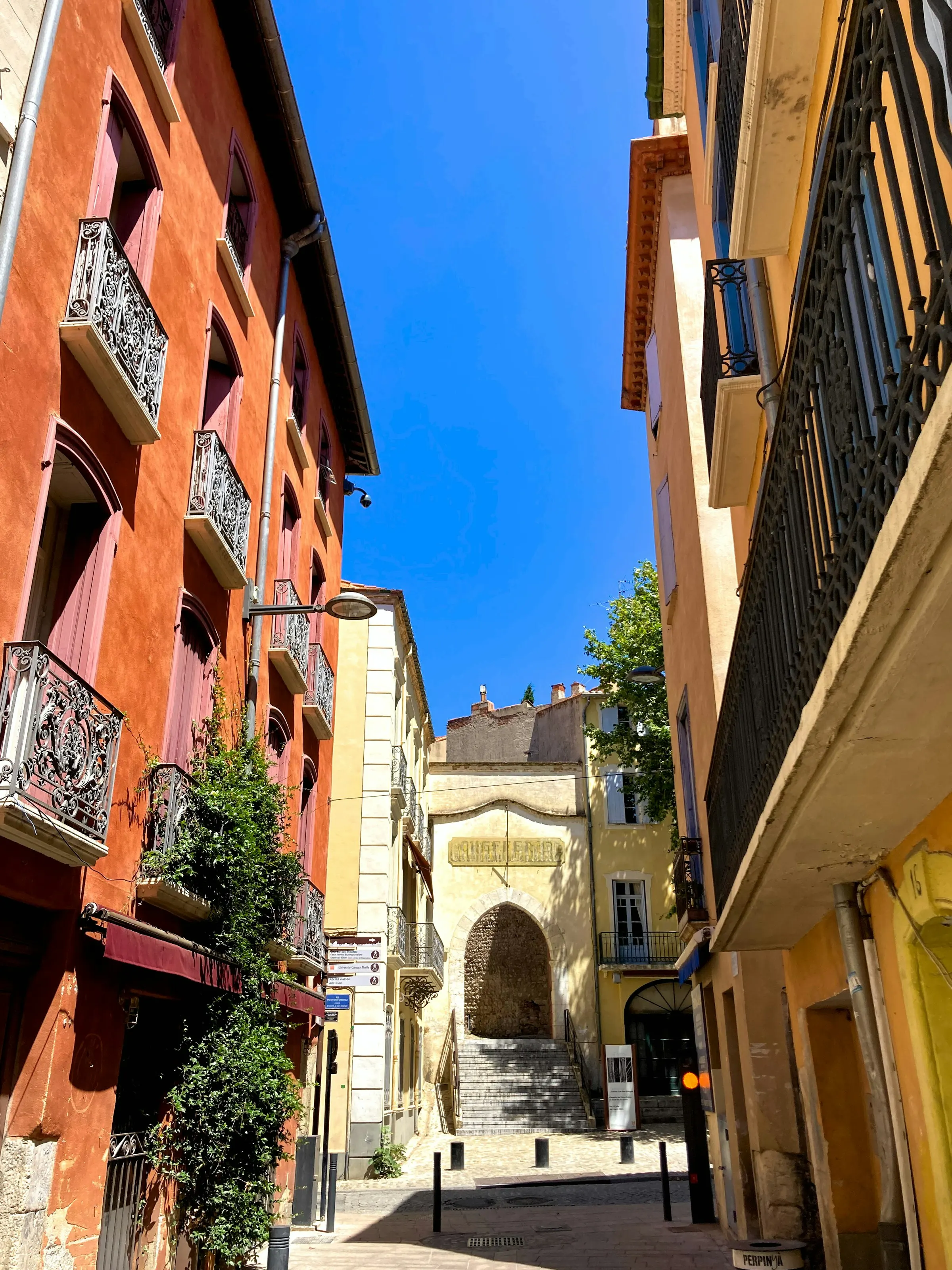
Stand on the Quai Vauban in winter and the geography does the talking: palms overhead, snow on Canigou closing the view down the street, Spain half an hour south. This is France's most Catalan city — the Kings of Majorca kept their court here, in the red-brick palace-fortress that still crowns the old town — and it is a working city, not a curated one. Some blocks of the center are worn and visibly poor; the boulevards are handsome and scruffy in the same glance. What Perpignan performs, it performs for itself.
Market day
Place Cassanyes, Tuesday through Sunday mornings, is one of the great southern markets nobody polished: peaches and tomatoes off the Roussillon plain beside North African spices and cheap textiles, half the city doing its week's shopping. The refined version is the Halles Vauban — the covered food hall on the quay, also Tuesday through Sunday — given over to the gourmet end of local produce. Between the two you have the whole city in miniature.
Where your coffee happens
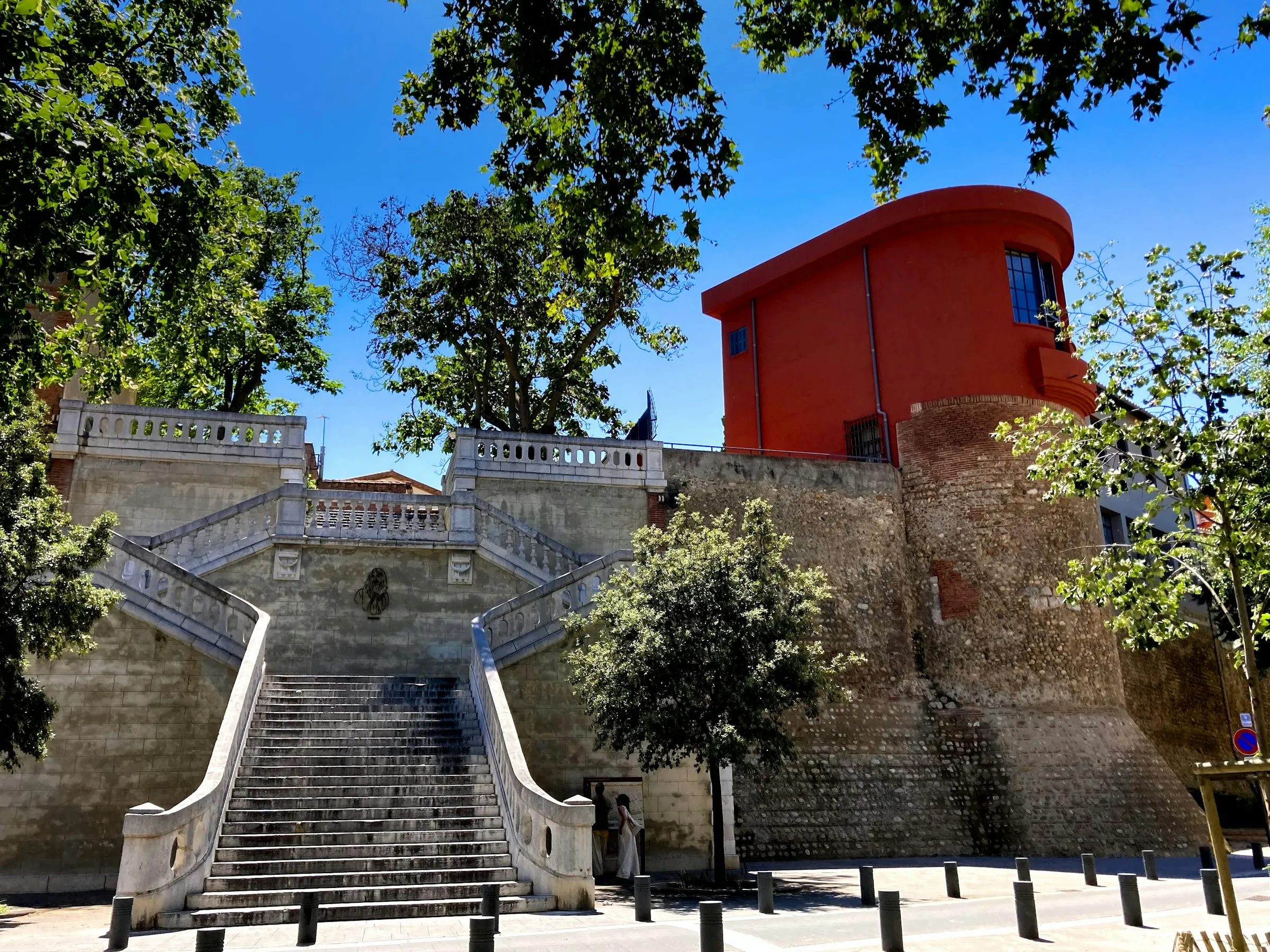
On the Quai Vauban, where the morning conversation runs through French, Catalan, Spanish, and Arabic; or under the Castillet, the red-brick medieval gate — now a museum — that anchors every view of the old town. Here the theatre is the crowd, not the architecture.
A Saturday here
Cassanyes early, coffee on the quay, then the climb through the old town to the Palais des Rois de Majorque: thirteenth century, red brick, gardens, and a rampart view that runs from the sea to the Pyrenees. Afternoon in Collioure, thirty minutes away, for a swim on the Vermilion Coast. And for two weeks from late August, Visa pour l'Image — the world's largest photojournalism festival — fills the city's convents and churches with free exhibitions and the Campo Santo with open-air screenings.
The year, honestly
The Météo-France station at Perpignan's own airport, twelve minutes north of town, logs about 2,490 hours of sun a year, fifty-four days of rain, and nine of frost — winter here is mostly a rumor. Summer is the bill: thirty-six days over 30 °C, and 109 over 25. The other asterisk is the tramontane, the dry northwest wind that arrives hard and can stay for days; locals treat it as furniture, newcomers need a year to get there. But this city belongs to its residents — barely four percent of homes are second homes — so nothing shuts in November. Nineteen festivals spread across the calendar, and the markets never pause.
Who thrives here
Value-first city people. Sales across the city averaged about €1,600 per square meter over 2022–2024 — among the cheapest sunny-city property in France — and it buys a real city: thirty-six listed monuments, two cinemas including an art-house screening films in the original language, a market every day but Monday. The department already leans retired — 29 percent of residents are 60 or older, against about 21 nationally. The anglophone scene is present but modest and largely British: an English-speaking club, the P-O Life webzine, an AVF welcome chapter. Come with French, or a plan to get it.
Think twice if
You're picturing postcard France. Unemployment runs high, the poverty in parts of the center is real and visible, and while the crime statistics sit mid-table for French cities, the rough edges deter some retirees. You wilt in heat or hate wind — you will get both. You want a university hospital close: the Saint-Jean hospital is six minutes away and everyday medicine is well covered, but the nearest CHU is Montpellier, roughly an hour and three-quarters. English-speaking medicine is thin — the US embassy's south-of-France provider list has no Pyrénées-Orientales entries. And budget for the taxe foncière: the combined 2025 rate is 50.5 percent.
The orbit
Collioure and the Vermilion Coast, thirty minutes; the Spanish border, about the same. Céret, up the Tech valley, for mountain air. Barcelona is about an hour and a half direct by high-speed train, usually five a day; Paris about five hours by rail. Perpignan–Rivesaltes airport, twelve minutes out, reaches the States with one stop via a hub.
The Aelos view
Perpignan is the value play of the French Mediterranean: more city, more sun, and more square meters per dollar than the polished towns on this coast can offer, with Barcelona effectively closer than Montpellier. We'd send members who want urban life with a Spanish orbit and don't need it prettified. We'd steer the village dreamers, the wind-averse, and anyone counting on deep English-speaking infrastructure toward gentler places.